
In this article
Key Takeaways
- M2M eSIM technology enables remote provisioning and management without physical access to IoT devices
- Traditional sim cards remain cost-effective for smaller deployments but create logistical challenges at scale
- Consumer eSIM standards differ significantly from M2M requirements, with distinct activation and lifecycle processes
- Physical sim cards offer proven reliability but limit flexibility for carrier changes and remote management
- GSMA standards provide the framework for both consumer and M2M eSIM implementations
- The choice between eSIM and traditional options depends on deployment scale, device accessibility, and operational requirements
Choosing between eSIM vs traditional SIM for M2M shapes your entire IoT deployment strategy. M2M connectivity needs differ from consumer mobile phones. They require specialized approaches to cellular connectivity management.
Traditional physical sim cards have served industrial applications for decades. But eSIM technology introduces new possibilities for remote provisioning and lifecycle management.
The decision impacts everything from initial deployment costs to long-term operational flexibility. Understanding these differences helps you select the right connectivity approach for your M2M devices and IoT applications.
- Understanding eSIM Technology for M2M Applications
- Traditional SIM Cards in M2M Deployments
- M2M vs Consumer eSIM Standards
- Connectivity Provisioning and Management
- Deployment Considerations and Use Cases
- Choosing the Right Solution for Your M2M Project
Understanding eSIM Technology for M2M Applications
An embedded sim (eUICC) represents a shift from removable physical sim cards to software-based profile management. The eSIM hardware gets soldered directly onto device circuit boards during manufacturing. This eliminates the need for physical SIM card slots and removable components.
M2M eSIM implementations follow GSMA standards. But they operate differently from consumer devices. Consumer eSIM typically requires users to scan a QR code through a user interface. M2M eSIM systems provision and activate profiles remotely without human involvement.
This remote capability becomes crucial for IoT devices deployed in hard-to-reach locations. Think underground sensors or high-altitude tracker systems.
Technical Architecture
The eUICC chip stores multiple operator profiles at the same time. This allows devices to swap between carriers without physical replacement. M2M eSIM architecture includes specialized components. These include the LPA (Local Profile Assistant) and SM-SR (Subscription Manager Secure Routing) for secure profile management.
These systems enable network providers to provision new profiles. They also manage existing ones throughout the device lifecycle.
Traditional SIM Cards in M2M Deployments
Physical sim cards remain the main connectivity solution for many M2M applications. These traditional physical sim card implementations provide proven reliability. They also offer broad compatibility across cellular networks.
Manufacturing processes are well-established. Costs remain predictable for organizations planning large IoT deployments.
Traditional sim cards work well in scenarios where devices require occasional manual maintenance. They also work when deployment teams can access equipment regularly. The process of activating physical sim cards follows established procedures. Most technical teams understand these procedures.
Many iot devices continue using this approach. It eliminates concerns about eSIM compatibility or remote provisioning failures.
Limitations in Scale
Physical sim cards create logistical challenges when managing thousands of m2m devices across wide geographic areas. Carrier changes require physical access to swap SIM cards. This makes it difficult to optimize connectivity costs or respond to coverage changes.
Each SIM card also represents a physical component that can fail. They can become dislodged or suffer environmental damage.
M2M vs Consumer eSIM Standards
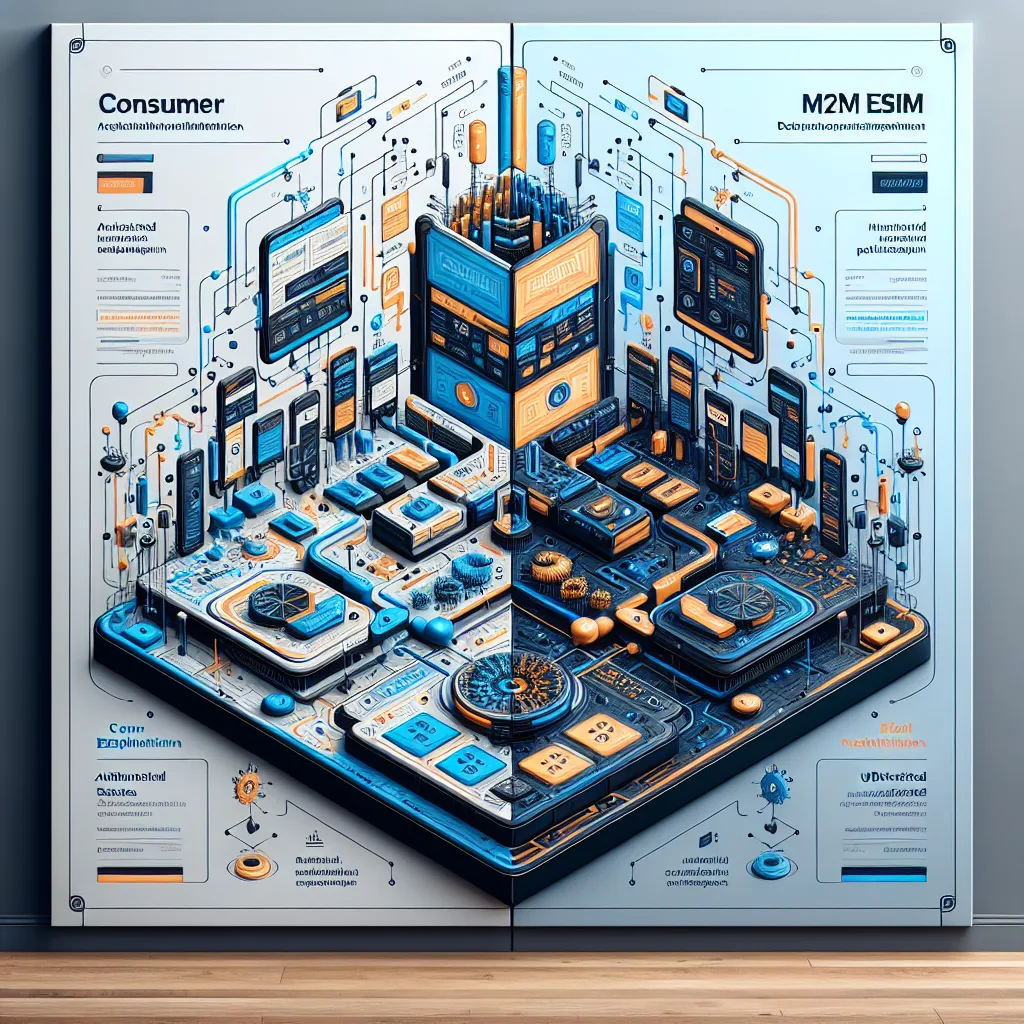
The m2m vs consumer distinction affects every aspect of eSIM implementation. Consumer standard eSIMs prioritize user control and manual activation processes. M2M implementations focus on automated, remote management capabilities.
These differences impact hardware requirements. They also affect activation procedures and ongoing profile management.
Consumer eSIM activations typically involve downloading profiles through mobile applications or carrier websites. Users receive QR codes containing profile information. They manually complete the activation process.
M2M eSIM systems eliminate human involvement. They use automated systems for remote sim provisioning and profile changes throughout the device lifecycle.
Profile Management Differences
M2M eSIM profiles support different operator profile structures compared to consumer implementations. Industrial IoT applications often require specialized connectivity features. These include private APN access, custom routing configurations, or specific quality-of-service parameters.
These requirements need different profile structures and management interfaces compared to standard consumer mobile connectivity.
Connectivity Provisioning and Management
Remote provisioning capabilities represent the primary advantage of eSIM technology for iot and m2m applications. Organizations can deploy devices with initial connectivity. Then they can modify carrier relationships, update profiles, or provision additional services without physical access.
This capability proves crucial for devices installed in remote locations. It also works for devices embedded within larger systems.
Traditional provisioning requires pre-configured physical sim cards inserted during manufacturing or deployment. Organizations must predict connectivity requirements and carrier relationships before device installation.
Changing these parameters requires technician visits and manual SIM card replacement. This increases operational costs and complexity.
Lifecycle Management
eSIM technology enables dynamic lifecycle management for M2M deployments. Devices can switch carriers based on coverage optimization, cost considerations, or service quality requirements.
Profile management systems allow administrators to activate, deactivate, or modify connectivity parameters remotely. This works throughout the operational lifecycle.
Physical SIM cards require replacement for major connectivity changes. This limits flexibility for long-term deployments. Organizations must plan carrier relationships carefully. Modifications require significant logistical effort and cost.
Deployment Considerations and Use Cases
Device accessibility significantly influences the esim vs traditional choice for M2M implementations. Connected vehicle systems, industrial sensors, and utility meters deployed in remote locations benefit from eSIM capabilities.
These use cases justify the additional complexity. Physical access for maintenance is expensive or impossible.
Smaller deployments with accessible devices may find physical sim cards more cost-effective. Projects with fewer than 100 devices often achieve better economics with traditional approaches. This is especially true when deployment teams can easily access equipment for maintenance.
Environmental Considerations
Many iot devices operate in challenging environments. Physical SIM card slots can create potential failure points. Moisture, dust, vibration, and temperature extremes can affect removable SIM card connections.
Embedded sim implementations eliminate these mechanical interface points. This improves long-term reliability for harsh environment deployments.
Global Deployment Scenarios
International M2M projects benefit significantly from eSIM technology. Devices can roam seamlessly between countries. They can switch to local carriers without physical intervention.
This capability reduces international roaming costs. It also improves connectivity reliability for global IoT deployments.
Choosing the Right Solution for Your M2M Project

The decision between eSIM and traditional SIM approaches depends on specific project requirements. Large-scale deployments with hard-to-reach devices typically justify eSIM complexity and costs.
Projects requiring frequent carrier optimization or international connectivity also benefit from eSIM flexibility.
Consider traditional physical sim cards for smaller deployments. They work well for cost-sensitive projects or applications where devices remain easily accessible.
Many organizations deploy hybrid approaches. They use eSIM technology for remote devices while maintaining physical SIM cards for accessible equipment.
Evaluate your deployment timeline, scale, accessibility requirements, and budget constraints. Understanding M2M SIM card fundamentals helps inform this decision. It clarifies the technical requirements for your specific use case.
eSIM Management Infrastructure for M2M Deployments
The SM-DP (Subscription Manager Data Preparation) server plays a crucial role in eSIM and M2M implementations. It handles profile downloads and device authentication.
Unlike traditional SIM cards that require physical swapping when switching carriers, eSIM profiles can be managed remotely. This happens through dedicated management platforms. This infrastructure enables businesses to streamline their IoT device deployments across multiple geographical regions. They don't need a physical presence at each location.
When evaluating traditional SIM vs M2M connectivity options, traditional approaches require manual SIM insertion. They also need carrier-specific configuration for each device activation.
The embedded SIM form factor eliminates this requirement. It integrates connectivity credentials directly into the device hardware. A new eSIM profile can be provisioned to any compatible device instantly. This allows one device to switch between multiple carrier networks. Switching is based on coverage optimization or cost considerations.
Global Connectivity and Device Usability Considerations
While consumer devices benefit from eSIM flexibility for frequent travelers, M2M applications demand more robust connectivity management. This works across diverse environments.
Connected devices in industrial settings require consistent global connectivity. They need this without the fragility risks of removable SIM cards. The subscriber identity module functionality remains the same. But eSIM implementations offer enhanced security through encrypted profile transfers and remote provisioning capabilities.
eSIM implementations provide long-term operational benefits that outweigh initial complexity. Device firmware updates can include connectivity profile changes. This enables dynamic carrier switching based on network performance metrics.
This approach transforms connectivity from a fixed hardware constraint into a software-managed service. The service adapts to changing operational requirements.
Frequently Asked Questions
What's the main difference between M2M eSIM and consumer eSIM?
M2M eSIM systems focus on automated, remote management without user interfaces. Consumer eSIM requires manual activation through apps or QR codes. M2M implementations support specialized connectivity features and remote provisioning capabilities that consumer devices don't need.
Can I switch carriers remotely with eSIM technology?
Yes, eSIM technology allows you to swap carrier profiles remotely without physical access to M2M devices. This capability enables cost optimization, coverage improvements, and service quality adjustments throughout the device lifecycle. No technician visits are needed.
Are physical sim cards more reliable than eSIM for IoT devices?
Physical sim cards offer proven reliability. But they create mechanical failure points through removable card slots. eSIM technology eliminates these mechanical interfaces. This potentially improves long-term reliability for harsh environment deployments. However, the technology is newer with fewer deployment years.
What are the cost implications of choosing eSIM vs traditional SIM?
eSIM implementations typically have higher initial costs. This is due to eUICC hardware and provisioning systems. But they reduce long-term operational expenses by eliminating manual SIM card management. Physical sim cards have lower upfront costs but create ongoing logistical expenses for large-scale deployments.
How does GSMA standardization affect my eSIM choice?
GSMA standards ensure interoperability between eSIM implementations and carrier systems. Following these standards enables compatibility with multiple network providers. It also simplifies the process of activating new profiles across different cellular networks.
Which option works better for international M2M deployments?
eSIM technology excels for international deployments. Devices can activate local carrier profiles without physical SIM card replacement. This capability reduces roaming costs and improves connectivity quality. Traditional approaches require pre-configured international SIM cards.
How does eSIM management differ from traditional SIM card handling in M2M deployments?
eSIM profiles can be managed remotely through centralized management platforms. This eliminates the need for physical SIM card replacements or on-site technician visits. Traditional SIM cards require manual handling when switching carriers or updating connectivity parameters. eSIM technology enables instant profile updates without physical intervention. This remote management capability significantly reduces operational costs and deployment complexity for large-scale M2M implementations.
Can eSIM technology streamline global IoT device deployments?
Yes, eSIM technology enables businesses to deploy connected devices globally with a single hardware configuration. They can then provision local carrier profiles remotely via SM-DP servers. This approach eliminates the need to source region-specific SIM cards or maintain multiple carrier relationships in each deployment location. The embedded SIM form factor ensures consistent global connectivity while reducing logistics complexity and inventory management requirements.
What usability advantages does eSIM offer for M2M applications compared to traditional solutions?
eSIM technology allows one device to store multiple carrier profiles at the same time. This enables automatic network switching based on coverage or cost optimization without hardware changes. The subscriber identity can be updated through firmware modifications. This provides flexibility that traditional SIM cards cannot match. For mobile M2M applications, this capability ensures continuous connectivity across different geographical regions and carrier networks.
When should businesses choose a new eSIM implementation over traditional SIM solutions?
Businesses should consider eSIM when deploying large numbers of connected devices that require flexible connectivity management or frequent carrier switching capabilities. A new device with eSIM capability offers superior longevity. Connectivity profiles can be updated remotely throughout the device lifecycle. eSIM provides the optimal choice for applications requiring global connectivity, remote management capabilities, or deployments in harsh environments where physical SIM card access is impractical.
Your choice between eSIM vs traditional SIM for M2M depends on balancing initial investment against long-term operational benefits. Selecting the right connectivity provider becomes equally important regardless of your SIM technology choice. Both approaches require reliable network partnerships for successful IoT deployments.
Related Articles
Industrial-Grade SIM Cards: Built for Extreme Environments
Industrial-grade SIM cards built for extreme environments give critical connections for iot devices placed in harsh conditions. Regular consumer SIM car...
Private APN for M2M: What It Is and Why You Need One
A private APN for M2M communication is a critical infrastructure choice. It can make or break your IoT deployment. Public internet connections might see...
Multi-Network Roaming for M2M: Steered vs Non-Steered SIMs
Multi-network roaming for m2m steered vs non-steered sims is a key decision for companies using iot solutions across different regions. The main differe...