
In this article
- MQTT excels in publish-subscribe scenarios with guaranteed message delivery and quality of service levels
- CoAP provides REST-like communication for resource-constrained IoT devices with low power requirements
- Real-time communication protocols offer bidirectional communication ideal for web-based applications and live data streaming
- Protocol selection depends on device constraints, network conditions, and specific application requirements
- MQTT runs over TCP for reliability, while CoAP uses UDP for efficiency in constrained environments
- Each protocol serves distinct IoT communication needs based on bandwidth, power consumption, and latency requirements
Selecting the right communication protocol can make or break your IoT project. Choosing between MQTT, CoAP, and real-time protocols means understanding how each handles message delivery and device limits. These three protocols dominate IoT communication. But each serves different needs.
MQTT works well when you need reliable message delivery through its publish-subscribe model. CoAP excels with constrained devices needing REST-like interactions. Real-time bidirectional protocols deliver instant communication perfect for web applications. Your protocol choice directly impacts performance, power use, and scalability.
This comparison examines the technical foundations and practical uses of each protocol. Understanding these differences helps you match protocol capabilities with your specific IoT requirements.
- MQTT Protocol Fundamentals
- CoAP Protocol Architecture
- Real-Time Communication Model
- Protocol Comparison Analysis
- IoT Use Case Scenarios
- Performance Considerations
- Protocol Selection Criteria
MQTT Protocol Fundamentals
MQTT (Message Queuing Telemetry Transport) operates as a lightweight messaging protocol. It was designed for IoT devices with limited processing power and bandwidth. The protocol uses a publish-subscribe architecture. Devices publish messages to topics. Subscribers receive messages from relevant topics through an MQTT broker.
The MQTT protocol runs over TCP. This provides built-in reliability for message delivery. This transport layer ensures packets arrive in order without corruption. MQTT offers three quality of service levels: QoS 0 (at most once), QoS 1 (at least once), and QoS 2 (exactly once). These levels balance reliability against network overhead.
MQTT Architecture Components
An MQTT broker serves as the central hub. It manages all message routing between publishers and subscribers. Publishers send messages without knowing which devices will receive them. Subscribers express interest in specific topics. They receive relevant messages automatically. This separation simplifies IoT systems and enables dynamic device connectivity.
MQTT uses persistent connections. These maintain continuous communication channels. The protocol includes keep-alive mechanisms. These ensure connection status monitoring. When a device disconnects unexpectedly, the broker can deliver stored messages once the device reconnects. This persistence makes MQTT suitable for unreliable network conditions.
MQTT Message Structure
MQTT messages consist of a fixed header, variable header, and payload. The fixed header contains control packet type and remaining length. Variable headers include protocol-specific information like topic names. Payloads carry actual application data with minimal overhead.
The protocol supports retained messages and last will testament features. Retained messages help new subscribers immediately receive the most recent value for critical topics. Last will testament enables devices to send predefined messages when they disconnect unexpectedly. This alerts other system components to device failures.
CoAP Protocol Architecture
CoAP (Constrained Application Protocol) provides REST-like communication for IoT devices with severe resource constraints. The CoAP protocol operates over UDP. This reduces overhead compared to TCP-based protocols. This approach suits battery-powered devices requiring minimal power consumption for extended operational life.
CoAP supports request-response interactions similar to HTTP but optimized for constrained devices. The protocol uses four message types: Confirmable (CON), Non-confirmable (NON), Acknowledgement (ACK), and Reset (RST). These message types provide reliability options ranging from fire-and-forget to guaranteed delivery.
CoAP Resource Model
CoAP organizes device functionality as resources identified by URI paths. Clients interact with resources using familiar HTTP methods: GET, POST, PUT, DELETE. This approach simplifies integration with web technologies. It maintains efficiency for constrained device communication.
The protocol includes built-in resource discovery mechanisms. Devices can advertise their available resources using well-known core links. Clients query these endpoints to discover device capabilities dynamically. CoAP supports block-wise transfers for handling large messages that exceed packet size limitations in UDP networks.
CoAP Reliability Mechanisms
Unlike UDP's inherent unreliability, CoAP provides optional reliability through confirmable messages. When a client sends a confirmable message, the server must respond with an acknowledgement. If no acknowledgement arrives within a timeout period, the client retransmits the message with exponential backoff.
CoAP supports observe relationships for monitoring resource changes over time. Clients register interest in specific resources. They receive notifications when values change. This mechanism enables efficient telemetry collection without constant polling. It reduces network traffic and power consumption.
Real-Time Communication Model
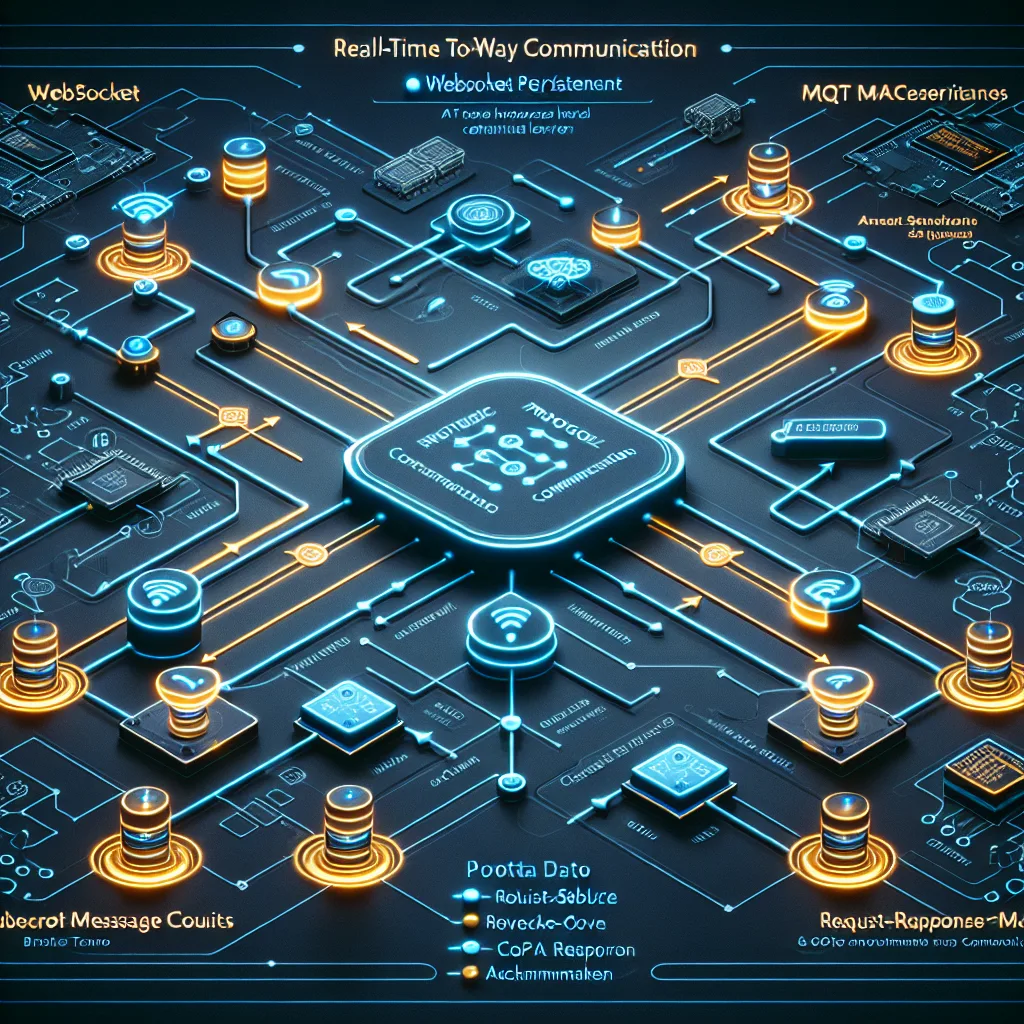
Real-time bidirectional protocols establish persistent communication channels between clients and servers over TCP. The protocol begins with an HTTP handshake that upgrades the connection to persistent mode. Once established, both endpoints can send messages freely without request-response constraints.
The bidirectional protocol provides full-duplex communication with minimal overhead after connection establishment. Messages can flow in both directions at the same time. This enables real-time data exchange. This capability makes real-time protocols ideal for applications requiring immediate data synchronization between web clients and IoT systems.
Real-Time Frame Structure
Real-time messages use a lightweight frame format optimized for efficient transmission. Frames include opcodes indicating message type (text, binary, close, ping, pong), payload length, and optional masking for security. This structure minimizes overhead while maintaining protocol flexibility.
The protocol supports fragmentation for large messages spanning multiple frames. Receivers reassemble fragments automatically. They handle variable message sizes transparently. Real-time protocols include built-in ping-pong mechanisms for connection keepalive and health monitoring.
Real-Time Integration Patterns
Real-time protocols excel in web-based IoT applications requiring immediate data visualization. Browsers maintain persistent connections to receive live sensor updates, alerts, and status changes. This approach eliminates polling overhead while providing immediate data availability.
The protocol integrates naturally with web technologies including JavaScript, REST APIs, and web frameworks. Developers can build responsive IoT dashboards and control interfaces using familiar web development tools and patterns.
Protocol Comparison Analysis
Each protocol addresses different IoT communication requirements through distinct approaches. MQTT and CoAP specifically target IoT scenarios. Real-time protocols provide general-purpose bidirectional communication suitable for web-based IoT applications.
Transport Layer Differences
MQTT operates over TCP. This provides guaranteed message delivery with automatic error correction and retransmission. This reliability comes with higher overhead and power consumption. CoAP uses UDP for minimal overhead but implements optional reliability mechanisms at the application layer. Real-time protocols also use TCP but focus on bidirectional communication rather than IoT-specific optimizations.
The choice between TCP and UDP significantly impacts battery life in IoT devices. UDP's connectionless nature reduces power consumption by avoiding connection state maintenance. However, applications requiring guaranteed delivery must implement reliability mechanisms. This potentially offsets UDP's efficiency advantages.
Message Delivery Models
MQTT's publish-subscribe model enables one-to-many and many-to-one communication patterns. Devices publish telemetry data once, reaching multiple subscribers automatically. This approach scales efficiently as subscriber numbers increase without impacting publishers.
CoAP follows a request-response model similar to HTTP. Clients initiate interactions with specific resources on target devices. This approach suits scenarios where clients need specific data or want to trigger device actions. CoAP supports multicast for efficient one-to-many scenarios.
Real-time protocols provide peer-to-peer communication without predefined patterns. Applications determine message routing and delivery semantics based on specific requirements. This flexibility accommodates diverse communication needs but requires more application-level protocol design.
IoT Use Case Scenarios
Different IoT applications benefit from specific protocol characteristics. Understanding these use case patterns helps identify the most appropriate protocol for your IoT project requirements.
MQTT Use Cases
MQTT excels in telemetry collection scenarios where sensors regularly publish measurements to central systems. Smart home applications use MQTT for device status updates and control commands. Industrial IoT systems leverage MQTT for equipment monitoring and alerting.
The protocol's offline message storage capabilities suit mobile IoT devices with intermittent connectivity. Agricultural monitoring systems use MQTT to collect data from remote sensors with unreliable cellular connections. The MQTT broker stores messages during connectivity outages and delivers them when devices reconnect.
CoAP Applications
CoAP serves battery-powered devices requiring minimal power consumption. Smart city sensor networks use CoAP for environmental monitoring with years-long battery life. Healthcare IoT devices leverage CoAP's efficiency for continuous patient monitoring applications.
CoAP works well in mesh networks where devices communicate directly without central infrastructure. Home automation systems use CoAP for local device interactions. This reduces cloud dependencies and improves response times.
Real-Time Protocol Scenarios
Real-time protocols suit applications requiring immediate data visualization. Manufacturing dashboards use persistent connections for live equipment status monitoring. Energy management systems leverage real-time communication for instant consumption tracking and alerts.
Web-based IoT control interfaces benefit from bidirectional capabilities. Users can monitor sensor data and control devices through responsive web applications without polling delays or page refreshes.
Performance Considerations

Protocol performance depends on network conditions, device capabilities, and application requirements. Each protocol optimizes different performance aspects based on its design goals and target scenarios.
Latency Characteristics
Real-time protocols provide the lowest latency for bidirectional communication due to persistent connections and minimal protocol overhead. Once established, message transmission occurs immediately without connection setup delays.
MQTT latency depends on broker processing and TCP connection management. The publish-subscribe model introduces slight delays as messages traverse through the broker. However, persistent connections minimize connection establishment overhead for frequent communication.
CoAP latency varies based on reliability requirements. Non-confirmable messages achieve very low latency. Confirmable messages include acknowledgement round trips. UDP's connectionless nature eliminates TCP handshake delays but may require application-level reliability mechanisms.
Bandwidth Efficiency
CoAP achieves excellent bandwidth efficiency through compact message formats and UDP transport. Binary encoding reduces header overhead compared to text-based protocols. The protocol's REST-like design enables efficient caching and compression.
MQTT provides good bandwidth efficiency for telemetry scenarios through compact binary encoding and topic-based routing. The protocol's persistent connections amortize connection overhead across multiple messages. Quality of service mechanisms add overhead but ensure reliable delivery when required.
Real-time protocol efficiency depends on application design and message patterns. The protocol's frame format minimizes overhead for small messages but lacks IoT-specific optimizations found in MQTT and CoAP.
Protocol Selection Criteria
Choosing the appropriate protocol requires evaluating multiple factors. These include device constraints, network conditions, and application requirements. This analysis helps match protocol capabilities with specific IoT communication needs.
Device Constraints
Resource-constrained IoT devices benefit from CoAP's minimal overhead and UDP efficiency. Battery-powered sensors requiring years of operation should prioritize power consumption over features. CoAP provides the necessary functionality while maximizing battery life.
Devices with adequate processing power and reliable connectivity can leverage MQTT's advanced features. The protocol's quality of service levels and broker-mediated communication suit complex IoT systems requiring guaranteed message delivery.
Web-connected devices and applications naturally fit real-time protocol capabilities. Browser-based IoT interfaces and monitoring applications benefit from bidirectional communication and web technology integration.
Network Conditions
Unreliable networks with frequent disconnections favor MQTT's persistence and offline message storage. The protocol's connection state management and automatic reconnection mechanisms handle network instability gracefully.
Bandwidth-limited networks suit CoAP's efficient UDP transport and compact message formats. The protocol's observe mechanism reduces polling traffic while maintaining data freshness.
Stable networks with low latency requirements can leverage real-time protocol capabilities. These protocols excel when immediate data delivery is more important than connection reliability.
Scalability Requirements
MQTT scales well for large deployments through topic-based routing and broker clustering. The publish-subscribe model handles thousands of devices efficiently while maintaining loose coupling between system components.
CoAP scales through resource-based addressing and multicast support. The protocol's stateless design enables horizontal scaling but requires careful resource management for large deployments.
Real-time protocol scaling depends on server architecture and connection management. The protocol's persistent connections require careful resource allocation but provide excellent performance for supported connection counts.
Protocol Selection for Internet of Things Applications
Choosing the right communication protocol depends heavily on your specific use case and device constraints. When evaluating any IoT protocol, consider factors like power consumption, network reliability, and message frequency. The difference between MQTT and other protocols often comes down to their design philosophy. MQTT technology focuses on publish-subscribe messaging while HTTP operates on request-response patterns.
Many IoT protocols have emerged to address different aspects of device connectivity. But MQTT, CoAP, and real-time communication protocols remain the most widely adopted. Unlike MQTT, which was specifically designed for IoT devices with limited resources, HTTP requires more overhead and processing power. MQTT enables efficient communication through its lightweight messaging structure. Protocols are used differently depending on whether you need real-time bidirectional communication or simple data collection.
Implementation Considerations for Different Device Types
IoT devices that need continuous monitoring benefit most from MQTT's persistent connection model. CoAP works better for battery-powered sensors that transmit data occasionally. MQTT client libraries are available for virtually every programming language and platform, making integration straightforward. The extensible messaging and presence protocol (XMPP) offers another alternative, though it's less common in modern IoT deployments.
Right IoT protocol selection also depends on your infrastructure requirements. Real-time protocols excel in web-based applications where you need instant updates. MQTT and HTTP combinations work well for hybrid architectures. MQTT also supports quality of service levels that guarantee message delivery, which is crucial for critical IoT apps. When comparing these protocols, consider that real-time communication maintains persistent connections like MQTT but lacks the built-in message queuing capabilities.
Selecting the right IoT protocol for your internet of things deployment requires understanding how each transfer protocol handles different scenarios. IoT communication protocols like MQTT are specifically designed for machine-to-machine communication. HTTP adapts existing web protocols for device connectivity. Specific protocols excel in particular environments. CoAP dominates in constrained networks, MQTT leads in reliable messaging, and real-time protocols provide the best web integration.
IoT protocols are a set of communication standards that determine how devices exchange data in connected systems. The success of an iot deployment often depends on selecting the right protocol for your specific use case and hardware constraints. When evaluating options, consider factors like power consumption, network reliability, and message overhead to ensure optimal performance.
For low-power iot applications, MQTT emerges as a strong candidate due to its publish-subscribe architecture and minimal bandwidth requirements. MQTT was designed specifically for resource-constrained environments where battery life matters most. An established MQTT connection can remain active with minimal power drain. This makes it ideal for sensors and remote monitoring devices.
CoAP is designed to work efficiently over UDP and provides RESTful communication for constrained devices. Whereas CoAP excels in direct device-to-device communication, it requires careful consideration of reliability mechanisms since UDP doesn't guarantee message delivery. Many iot devices benefit from CoAP's lightweight nature, especially when building applications that need quick request-response patterns.
Protocol Selection for Different IoT Scenarios
Low-energy iot deployments often require specialized protocols that minimize radio transmission time and optimize sleep cycles. A protocol like mqtt provides excellent power efficiency through its keep-alive mechanisms and quality of service levels. Real-time connections work well for monitoring dashboards but consume more power than protocols that can maintain persistent connections with less overhead.
Cloud platforms like aws iot support multiple protocol options. This allows developers to choose between mqtt or http depending on their application requirements. CoAP is used frequently in mesh networks and edge computing scenarios where direct peer-to-peer communication reduces latency. The most suitable for iot applications depends on your specific bandwidth, power, and reliability constraints.
Future-Proofing Your IoT Architecture
Building a future-proof iot system requires evaluating both current needs and potential scaling requirements. New protocols continue emerging, but established standards like MQTT, CoAP, and real-time communication protocols provide proven reliability and broad ecosystem support. Consider protocols that offer flexibility for different device types while maintaining compatibility with existing infrastructure and cloud services.
Modern IoT architectures require careful protocol selection to ensure optimal performance across diverse device ecosystems. Engineers familiar with HTTP often gravitate toward CoAP due to its REST-like structure. This makes the transition from web development to IoT implementation more intuitive. The protocol choice directly impacts scalability, power consumption, and maintenance complexity in production deployments.
When evaluating different IoT protocols, consider your specific use case requirements and constraints. Real-time protocols excel in bidirectional communication scenarios. MQTT dominates in publish-subscribe messaging patterns. CoAP may offer the best balance for resource-constrained devices requiring REST semantics. Each protocol addresses distinct challenges in IoT systems.
Protocol Selection Framework
The CoAP vs MQTT vs real-time protocol decision hinges on three critical factors: network topology, device capabilities, and communication patterns. CoAP's UDP foundation reduces overhead for simple request-response interactions. MQTT's TCP reliability suits mission-critical telemetry applications. Real-time protocols provide the lowest latency for interactive applications requiring immediate data synchronization.
Selecting the one that best fits your IoT deployment requires analyzing power budgets, network reliability, and message frequency patterns. Battery-powered sensors typically benefit from CoAP's lightweight design. Always-connected devices can leverage persistent connections for enhanced responsiveness. MQTT's quality of service levels make it ideal for applications where message delivery guarantees are paramount.
Frequently Asked Questions
Who should use real-time protocols vs MQTT vs CoAP for their IoT project?
Choose MQTT for reliable telemetry collection and device management in IoT systems requiring guaranteed message delivery. Select CoAP for battery-powered constrained devices needing efficient communication with minimal overhead. Use real-time protocols for web-based IoT applications requiring bidirectional communication between browsers and IoT devices. The choice depends on your specific device constraints, network conditions, and application requirements.
Are real-time protocols better than MQTT and CoAP for IoT applications?
Real-time protocols aren't universally better. Each protocol serves different IoT communication needs. Real-time protocols excel for web applications but lack IoT-specific optimizations. MQTT provides better reliability and offline capabilities for traditional IoT telemetry. CoAP offers superior efficiency for constrained devices. The best protocol depends on your specific use case, device capabilities, and network conditions rather than universal superiority.
Which protocol offers the best reliability for IoT communication?
MQTT provides the most comprehensive reliability features through its quality of service levels and TCP transport layer. The protocol ensures message delivery even during network disruptions through broker persistence and automatic retransmission. CoAP offers optional reliability through confirmable messages but relies on UDP for basic transport. Real-time protocols provide TCP reliability but lack IoT-specific delivery guarantees and offline message storage capabilities.
How do power consumption requirements affect protocol selection?
CoAP consumes the least power due to UDP transport and minimal connection overhead. This makes it ideal for battery-powered IoT devices. MQTT requires more power for TCP connections but offers better reliability for critical data transmission. Real-time protocols' persistent connections consume moderate power but provide instant capabilities. Consider your device's power budget and operational lifetime when selecting between protocols. Constrained devices typically benefit from CoAP's efficiency.
Can these protocols work together in the same IoT system?
Yes, many IoT systems use multiple protocols at the same time based on component requirements. Edge devices might use CoAP for local communication between devices while using MQTT to send telemetry to cloud systems. Web dashboards can use real-time protocols for data visualization while the backend processes MQTT messages from field devices. Protocol gateways enable interoperability between different communication protocols within the same IoT solution.
What security considerations apply to each protocol?
All three protocols support encryption through TLS/DTLS implementations. MQTT typically uses TLS over TCP with additional authentication mechanisms at the broker level. CoAP implements DTLS over UDP for secure constrained device communication. Real-time protocols use TLS for secure connections with additional authentication handled by web application frameworks. Consider your security requirements and device capabilities when implementing protocol-specific security measures in your IoT communication architecture.
What makes MQTT different from HTTP for IoT applications?
MQTT operates as a lightweight publish-subscribe protocol for iot devices, consuming significantly less bandwidth and battery power than HTTP. Unlike HTTP's request-response model, MQTT maintains persistent connections and allows one-to-many message distribution. This makes it ideal for iot apps that require real-time data streaming.
Which protocol works best for battery-powered IoT sensors?
CoAP typically performs better than other iot communication protocols for battery-powered devices due to its UDP-based architecture and built-in sleep mode support. While choosing the right communication protocol depends on specific requirements, CoAP's lightweight design helps iot devices that need to conserve power while maintaining reliable connectivity.
Can real-time protocols replace MQTT in IoT deployments?
Real-time protocols serve different purposes than mqtt technology, excelling in web-based applications rather than traditional IoT sensor networks. Many iot protocols are designed for specific use cases. Real-time protocols provide excellent browser integration, while mqtt client libraries offer better support for resource-constrained devices and guaranteed message delivery.
How do I choose between these three protocols for my IoT project?
The right iot protocol selection depends on your device capabilities, network conditions, and application requirements. Consider MQTT for reliable sensor data collection. Use CoAP for battery-powered devices in constrained networks. Choose real-time protocols for web-based monitoring applications that need seamless browser integration.
What makes a protocol the best iot protocol for my application?
The best iot protocol depends on your specific requirements including power consumption, message frequency, and network topology. Low-power iot devices typically benefit from MQTT's efficient publish-subscribe model, while real-time applications may require bidirectional communication. Evaluate factors like device battery life, data payload size, and connectivity patterns before making your selection.
How do I choose between specialized protocols and standard web protocols?
Specialized protocols like MQTT and CoAP optimize for iot constraints such as limited bandwidth and battery life. Standard web protocols offer broader compatibility. Many iot devices require the efficiency that specialized protocols provide, especially in remote or battery-powered deployments. Consider your infrastructure capabilities and whether you need features like quality of service guarantees or RESTful communication patterns.
Can I use multiple protocols in the same IoT system?
Yes, hybrid architectures commonly use different protocols for different system components to maximize efficiency. You can implement CoAP for device-to-device communication while using MQTT for cloud connectivity. This creates a future-proof iot solution. Protocol gateways can bridge between different communication standards, allowing you to leverage the strengths of each protocol where most appropriate.
What role do new protocols play in IoT development?
New protocols continue evolving to address emerging iot challenges like edge computing and 5G connectivity. But proven standards remain the foundation for most deployments. Successful iot implementations typically start with established protocols that offer robust ecosystem support and extensive documentation. Monitor protocol developments but prioritize stability and compatibility when building production systems that need long-term reliability.
Which protocol works best for battery-powered IoT devices?
CoAP may be the optimal choice for battery-powered devices due to its UDP-based design and minimal protocol overhead. The stateless nature of CoAP reduces memory requirements and allows devices to sleep between transmissions. This significantly extends battery life compared to connection-oriented protocols.
How do I choose between these different IoT protocols for my project?
Start by analyzing your IoT architectures and communication patterns to determine the one that best matches your requirements. Consider factors like device power constraints, network reliability, message frequency, and whether you need real-time bidirectional communication or simple sensor data collection.
Are real-time protocols suitable for developers already familiar with HTTP?
Yes, developers familiar with HTTP will find real-time protocols relatively easy to adopt since they use HTTP for the initial handshake before upgrading to persistent mode. The transition is seamless, and many existing HTTP libraries support persistent connections. This makes integration straightforward for web developers entering IoT development.
When should I avoid using CoAP vs other protocols?
Avoid CoAP when you need guaranteed message delivery or complex routing scenarios, as its UDP foundation doesn't provide built-in reliability mechanisms. MQTT or real-time protocols better serve applications requiring persistent connections, complex message queuing, or scenarios where network conditions are unpredictable and message loss is unacceptable.
The decision between MQTT vs CoAP vs real-time protocols choosing the best protocol depends on your specific IoT requirements. MQTT delivers reliable messaging through its broker-based architecture and quality of service guarantees. CoAP provides efficient communication for constrained devices through UDP transport and REST-like interactions. Real-time protocols offer bidirectional communication ideal for web-based IoT applications. Evaluate your device constraints, network conditions, and application needs to select the protocol that best matches your IoT communication requirements. Many successful IoT systems combine multiple protocols, using each where it provides the greatest advantage for specific communication patterns and device capabilities.
Related Articles
How MQTT Brokers Work: Architecture and Best Practices
Message brokers function as the central communication hub in IoT architecture. They manage message routing between connected devices through a publish-s...
OPC UA for Industrial M2M Communication
Manufacturing operations need strong communication protocols. These protocols connect old systems with new IoT infrastructure. OPC UA for industrial m2m...
M2M Communication Protocols: A Complete Comparison Guide
M2M communication protocols form the foundation of modern IoT systems. They let billions of devices talk to each other without human help. This guide lo...